About
Disability Connect Leadership Charter
Vision
To build a professional, credible network that connects young Deaf South Africans to real employment, leadership, and economic opportunities.
Mission
To position Deaf people as skilled, empowered contributors to South Africa’s economic future through jobs, internships, leadership development, and professional networks.
Our Identity
DEAF CONNECT is a gateway to economic empowerment, not a personality platform.
Our focus is systemic change, not surface-level visibility.
Membership Expectation
Everyone who engages with DEAF CONNECT commits to professionalism, growth, and the dignity of the Deaf community.
Core Principles
Professionalism First: This is a networking and opportunity group, not a charity or activist platform.
Impact Over Attention: We measure success by real outcomes, job placements, leadership growth, and systemic inclusion.
Credibility Matters: Every member represents the larger Deaf community. We act with dignity, respect, and purpose.
No Drama, No Distractions: We focus on building futures, not managing crowds or social debates.
Collaboration With Purpose: We work with employers, partners, and credible institutions aligned to Deaf empowerment.
Meet Lisa Msiza

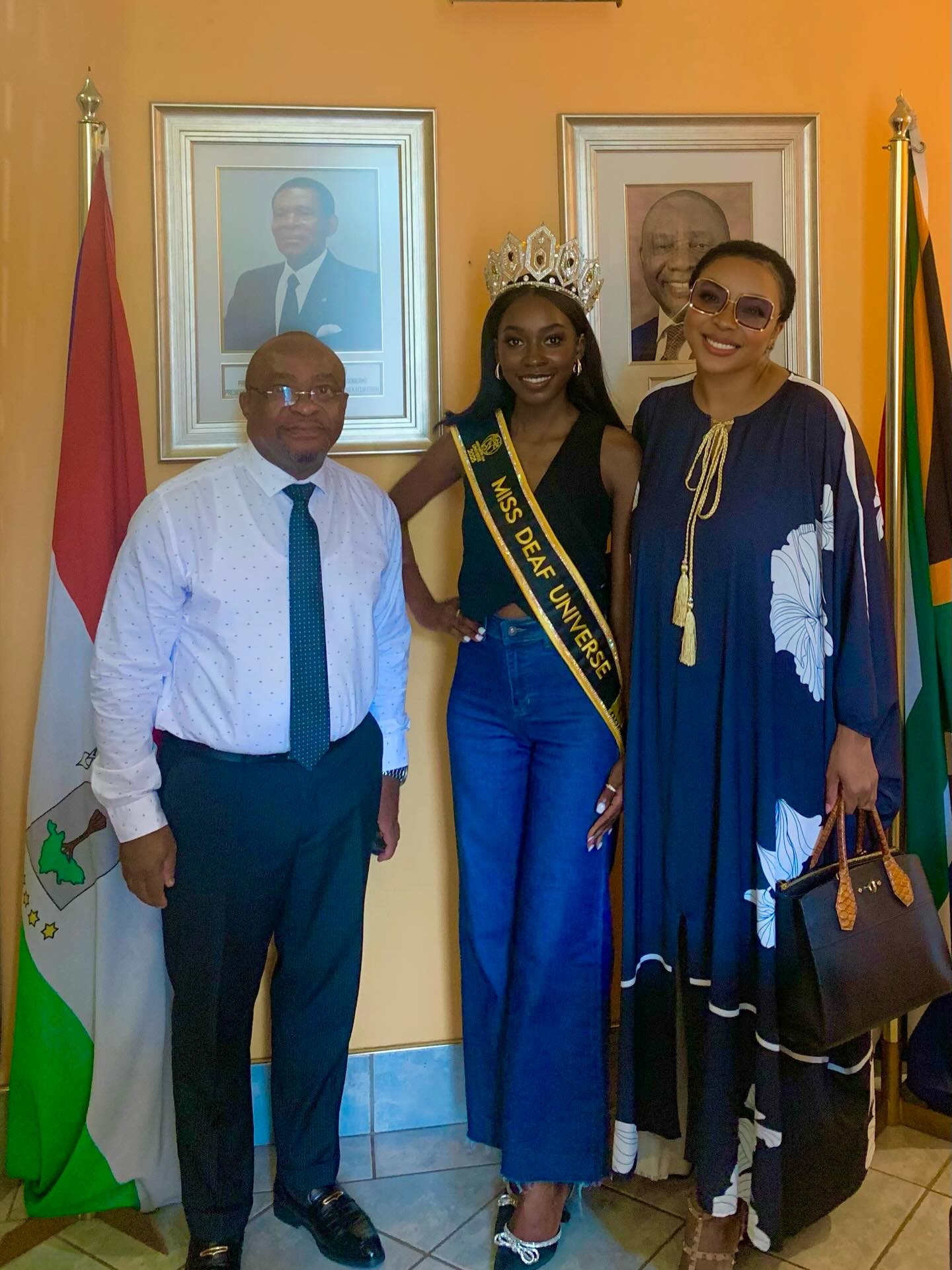
Reigning Miss Deaf Universe
Lisa Msiza represents a new generation of Deaf leadership in South Africa: intellectually rigorous, culturally grounded, and globally positioned.
She holds a Bachelor of Arts degree in Linguistics and South African Sign Language from the University of the Free State and is currently completing her Postgraduate Certificate in Education at the University of the Witwatersrand. Her academic trajectory reflects both depth and discipline, positioning her as a future thought leader within Deaf education and language development.
Her professional experience includes teaching at Sizwile School for the Deaf and St Vincent School for the Deaf, where she has contributed directly to Deaf learner development and inclusive pedagogy. Her classroom presence is not symbolic. It is operational. She understands the systemic barriers facing Deaf learners because she works inside them daily.
Lisa’s academic excellence has been formally recognised through the ABE Bailey Travel Bursary and her induction into the Golden Key International Honour Society, distinctions awarded to high-performing scholars demonstrating leadership potential and academic merit.
Beyond academia, Lisa embodies entrepreneurial foresight. She is actively exploring innovation within Deaf learning environments and inclusive content creation spaces. She understands that representation without economic participation is incomplete. Her leadership integrates education, advocacy, and forward-thinking enterprise development.
Lisa does not rely on amplification devices to command influence. Her authority is built on scholarship, service, and strategic clarity. She represents not only personal achievement, but the intellectual capital of the Deaf community in South Africa.
As the reigning Miss Deaf Universe, she stands as a national symbol of Deaf brilliance, dignity, and disciplined excellence.
In 2026, she will formally hand over her crown to the next Miss Deaf Universe South Africa, continuing a legacy that positions Deaf leadership not as ceremonial, but as structural.
Uyanda Mbuli Corporation | Disability Sector Positioning Statement
Uyanda Mbuli Corporation operates on a simple conviction: disability inclusion is not philanthropy, and it is not compliance. It is economic infrastructure.
UMC functions as a systems-level strategic advisory firm embedding disability and Deaf leadership into institutional design, economic strategy, and public architecture. We do not treat disability as a marginal social issue. We treat it as a structural variable that determines whether societies expand or stagnate.
As the firm evolves, UMC is consolidating its authority within the disability sector by integrating Deaf leadership directly into its governance, advisory, and implementation architecture. Our work moves beyond awareness and beyond policy rhetoric. We design power transfer mechanisms that reposition historically excluded communities as economic participants, cultural producers, and institutional co-architects.
Our areas of strategic focus include inclusive economic design, where disability is embedded within enterprise development, ESG strategy, procurement systems, and capital allocation frameworks. We build Deaf empowerment pathways that scale leadership pipelines, employment channels, and global representation platforms. We advise institutions on policy transformation strategies that move beyond performative access into structural redesign. We engineer SASL integration models across early childhood development, education systems, technology platforms, and workforce participation. We construct culturally intelligent communication frameworks that ensure equity is not merely spoken about, but operationalised through language, representation, and structural access.
Our methodology is co-designed with Deaf and disabled leaders, grounded in lived experience, and executed with institutional discipline. Inclusion, in our model, is not an add-on feature. It is the organising principle.
UMC does not offer proximity to power. We design the redistribution of it.
Our mandate is clear: to reposition South Africa’s 4.4 million Deaf citizens, and the broader disability community, from the margins of economic design to the centre of national development.
We are not disrupting systems for spectacle.
We are rebuilding them for permanence.